Which table lamp puts enough light on a page without glare?
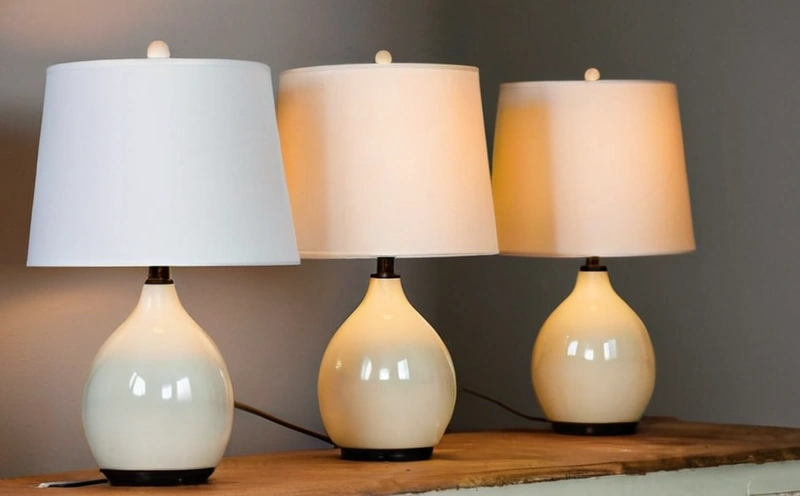
Buying table lamps on appearance produced two returns and two keepers. Photographs hide the four properties that decide whether a lamp works beside a chair: lux landing on the page, whether the bulb enters a seated line of sight, where the switch sits, and how far the cable reaches. A light meter, a tape measure and nine weeks of evening reading sorted the four lamps into a clear order.
How much light does a table lamp actually put on the page?
Four lamps running the identical 806 lumen, 8 W, 2700 K LED bulb delivered between 62 lux and 310 lux on an open paperback, measured 400 mm below the shade opening. Shade lining, shade opening diameter and bulb height inside the shade produced a fivefold spread from a single bulb.
Bulb lumens describe the bulb and not the lamp. Reading a paperback comfortably needs roughly 200 lux at the page for most adults, and more after about the age of fifty. Two of the four lamps cleared 200 lux, and the AED 260 ceramic lamp delivered 62 lux, which lights a side table and does not light a book.
| Lamp | Shade | Shade diameter | Lining | Lux at page | Price |
|---|---|---|---|---|---|
| Brass column | Wide linen drum, open below | 380 mm | White | 310 lux | AED 480 |
| Paper shade | Closed paper cylinder | 250 mm | None, paper only | 96 lux | AED 150 |
| Clip lamp | Steel cone, tight opening | 180 mm | White | 240 lux | AED 65 |
| Ceramic base | Fabric drum, deep skirt | 320 mm | Dark grey | 62 lux | AED 260 |
Shade lining explains most of the spread. A white lining bounces light back down into the pool, while the dark grey lining in the ceramic lamp absorbs a large share of the same 806 lumens. Shade diameter changes the shape rather than the total: the 380 mm brass drum spread light across a pool roughly 900 mm wide, and the 180 mm steel cone concentrated a 350 mm pool at higher intensity.
When does a table lamp cause glare at seated eye height?
A table lamp causes glare when the bulb sits below the lower shade rim as seen from a seated eye height of about 1.10 m. The brass column lamp, a 450 mm body on a 550 mm side table, put the LED filament at 1.09 m and left an after-image on every sideways glance.
Checking for glare takes one action and no instrument: sit in the chair that will stand beside the lamp, look straight ahead, and see whether the bulb appears under the shade rim. Eye height in a normal armchair sits near 1.10 m above the floor for an adult of 175 cm, which is why side table height and lamp body height matter more than shade fabric.
| Lamp | Body height | Bulb against the lower shade rim | Filament height above floor | Bulb visible when seated |
|---|---|---|---|---|
| Brass column | 450 mm | 40 mm below the rim | 1.09 m | Yes, direct view of the filament |
| Paper shade | 380 mm | Fully enclosed by a closed cylinder | 0.99 m | No |
| Clip lamp | 320 mm | 60 mm inside a steel cone | 0.92 m | No, hidden above 25 degrees from the tabletop |
| Ceramic base | 400 mm | 30 mm inside the drum | 0.97 m | No |
The AED 65 clip lamp solves glare through shape rather than through dimming. A deep steel cone holds the bulb 60 mm inside the shade, so the filament stays hidden from any viewpoint above roughly 25 degrees from the tabletop. Directional shape has a cost: the pool of light lands where the cone points and lights a book rather than a room.
Where should the switch sit and how long should the cable be?
Switch position and cable length decide how often a lamp gets switched on. Two of the four lamps on this page use an inline rocker on the cable, one uses a rotary knob under the shade, and one uses a toggle on the head. Cable lengths measured 1.2 m, 1.5 m, 1.8 m and 2.2 m.
| Lamp | Switch | Position | Cable | Findable in the dark |
|---|---|---|---|---|
| Brass column | Rotary knob | Under the shade, beside the bulb holder | 1.8 m | Yes, but within 15 mm of a hot holder |
| Paper shade | Inline rocker on the cable | 300 mm from the plug, near the floor | 2.2 m | No, needs reaching behind furniture |
| Clip lamp | Toggle on the head | Back of the cone, reachable by touch | 1.5 m | Yes |
| Ceramic base | Inline rocker on the cable | 600 mm from the lamp base | 1.2 m | Yes, the rocker lands on the tabletop |
An inline rocker 300 mm from the plug means reaching towards a floor socket behind furniture every evening, which is why the paper shade lamp got used least across nine weeks. A rocker 600 mm from the lamp base lands on the tabletop and works well. The rotary knob on the brass lamp sits within 15 mm of the bulb holder, which reaches roughly 70 C after an hour and needs a careful hand.
Cable length caused the only outright return. The 1.2 m cable on the ceramic lamp could not reach a socket 1.7 m away, and an extension lead across a walkway was not acceptable. Measuring the distance from the intended lamp position to the intended socket before buying takes 20 seconds and prevents that outcome.
Light meter readings taken on 20 May 2026 in a room with no other light source, repeated on 30 July 2026. Related reading: three kettles compared.