What makes a dining chair comfortable for a two hour dinner?
Updated:
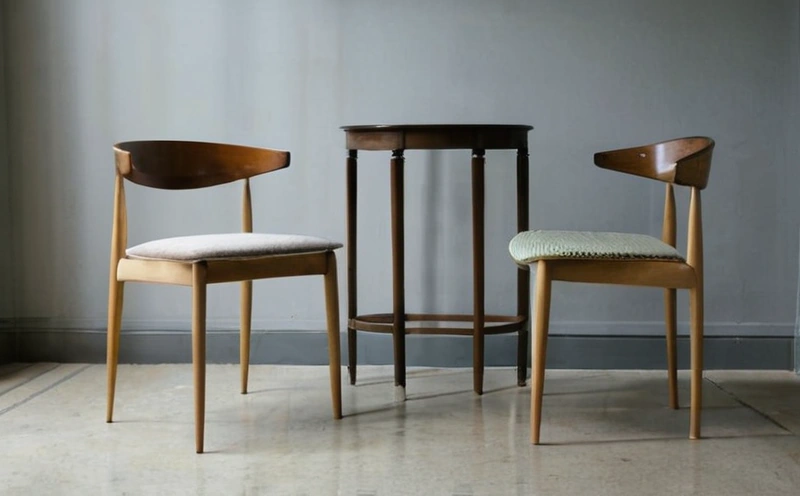
A brief showroom test reveals almost nothing about a dining chair. Two minutes of sitting flatters every seat, while a chair that felt fine in the shop can push a person to stand up 40 minutes into a dinner. Six months of long meals identified three measurements that predicted comfort better than price or padding thickness: seat depth in millimetres, seat angle in degrees, and front edge radius. Mattress comfort also depends on measurable construction details explained in a mattress specification guide.
What seat depth keeps a dining chair comfortable?
Seat depth of 400 to 440 mm, measured from the front edge to the point where the seat meets the backrest, suited adults between 160 cm and 185 cm tall across the five chairs measured here. Depth in that band lets the pelvis reach the backrest while leaving two to four fingers of gap behind the knee.
Excess depth causes a specific failure. A 470 mm seat forces a choice between two bad postures: sit fully back and let the front edge press into the calf, or slide forward and lose all contact with the backrest. Four of five test sitters slid forward, which turns a dining chair into a stool with a decorative panel behind the shoulders. Slouching followed within half an hour, and lower back ache followed the slouch.
Shallow seats fail faster. A 350 mm seat supports only the rear half of the thigh, so body weight concentrates on the two sitting bones. Pressure at that point became noticeable at roughly 25 minutes and uncomfortable at 45 minutes across three timed dinners.
| Chair | Seat depth | Seat angle | Front edge radius | Seat height | Comfortable to | Price |
|---|---|---|---|---|---|---|
| Beech side chair, woven seat | 420 mm | 4 deg back | 22 mm | 455 mm | Over 2 h | AED 145 |
| Upholstered box seat, 60 mm foam | 445 mm | 2 deg back | 18 mm | 470 mm | About 90 min | AED 390 |
| Designer plywood shell | 470 mm | 0 deg, flat | 4 mm | 440 mm | About 40 min | AED 620 |
| Metal cafe chair, pressed seat | 390 mm | 3 deg back | 10 mm | 450 mm | About 70 min | AED 210 |
| Oak carver with arms | 430 mm | 5 deg back | 25 mm | 460 mm | Over 2 h | AED 540 |
Price predicted comfort badly across those five chairs. The AED 620 plywood shell scored worst on all three measurements, and the AED 145 beech chair scored best on two of the three at a quarter of the money.
What seat angle should a dining chair have?
A dining seat tilted 3 to 5 degrees back from level holds the pelvis against the backrest without muscular effort. A flat seat measured at 0 degrees produced fidgeting inside one hour across three test dinners, and tilts beyond about 7 degrees made standing up awkward for anyone with a stiff knee.
A digital angle gauge laid across the seat returns the figure in about five seconds, and shop staff almost never know the number. Gravity does the work that abdominal muscles otherwise do, so a sitter on a 4 degree seat stops making the small corrections that a flat seat demands every few minutes.
Seat height changes what a given tilt achieves. A 460 mm seat under a 750 mm tabletop leaves 290 mm between seat and tabletop, which clears a 60 mm apron for most adults. Raising the seat to 480 mm at the same 4 degree tilt drops that gap to 270 mm, and knees then press against the apron, which cancels the benefit of the tilt entirely.
| Seat height | Tabletop height | Seat to tabletop gap | Clearance under a 60 mm apron | Result over two hours |
|---|---|---|---|---|
| 420 mm | 750 mm | 330 mm | 270 mm | Forearms sit below the table edge, shoulders lift |
| 440 mm | 750 mm | 310 mm | 250 mm | Comfortable for adults under 170 cm |
| 460 mm | 750 mm | 290 mm | 230 mm | Comfortable for adults 160 to 185 cm |
| 470 mm | 750 mm | 280 mm | 220 mm | Thighs touch the apron on a 4 degree tilt |
| 480 mm | 750 mm | 270 mm | 210 mm | Knees press the apron, tilt stops helping |
Why does the front edge of a chair seat make a thigh go numb?
A front edge radius under about 10 mm concentrates body weight on a narrow band of thigh directly over the femoral artery. The plywood shell chair, with a 4 mm radius, produced a numb patch after roughly 40 minutes in three separate dinners. A 22 mm waterfall edge on the beech chair spread the same load without complaint.
A rounded edge of 15 mm or more distributes the load across a wider band of tissue, which is why traditional chairmakers shape a waterfall edge on a solid timber seat. Upholstery can meet the same requirement, though only where the foam wraps the front rail rather than sitting on top of a square frame. Pressing a thumb into the front edge settles the question in one second, because a hard rail under 10 mm of foam still feels like a hard rail.
How do you check a dining chair in three minutes in the shop?
Five checks take under three minutes and need only a tape measure and a phone. Seat depth, seat angle, front edge radius, knee gap and a timed ten minute sit catch the failures that a two minute showroom test hides. Discomfort felt at ten minutes turns into pain at ninety minutes.
- Measure seat depth with a tape. Anything outside 395 to 445 mm needs a good reason.
- Put a phone running a level app on the seat. Look for 3 to 5 degrees of backward tilt.
- Run a thumb along the front edge. A radius smaller than a 7 mm pencil is a warning.
- Sit back fully and check for two to four fingers of gap behind the knee, roughly 40 to 70 mm.
- Stay seated for ten minutes, phone away, both feet flat on the floor.
Measurements taken on 8 June 2026 and rechecked on 2 August 2026. Related reading: reading a mattress spec.